Algae are a symptom, not a disease. Almost every outbreak has a specific cause — too much light, a missing macronutrient, unstable CO₂, or poor flow. This guide helps you identify what you're looking at and make decisions based on the cause, not on some "golden rule" you found on a forum.
Nine sections: fundamentals, a visual identification guide, an action plan per type, and emergency measures. Use it as a diagnostic manual — come back when something new shows up on the glass.
1. Why algae appear
Algae compete with plants for the same resources: light, CO₂, macro and micronutrients. When plants grow slowly or can't use available resources, algae fill the niche.
Three actual root causes
- Imbalanced resources — usually too much light relative to available CO₂ or nutrients. Plants can't keep up; algae can.
- Unstable CO₂ (in injected tanks) — uneven dosing, a cylinder running out mid-photoperiod, CO₂ turning on too late. BBA and staghorn are classic symptoms.
- Excess organic matter — leftover food, rotting leaves, dead fish. Phosphate and humic compounds feed algae before plants can use them.
What NOT to believe about algae
Popular myths worth ignoring:
- "Nitrate and phosphate feed algae." They do — but they feed plants too. Macro deficiencies favour algae more than their presence (see: GSA from phosphate deficiency).
- "A fresh tank must have algae." It doesn't have to — but often does. It's a period when the bacterial colony is still stabilising and plant roots aren't strong enough to compete.
- "Reduce dosing to beat algae." Usually makes things worse. Plants weaken; algae spread easier.
2. The golden rule of algae control
Fix the plants and algae fade on their own. Most "anti-algae" interventions amount to cutting light, dosing and feeding — which in practice weakens plants and deepens the problem.
Three things to check before you reach for an algicide:
- Light: 6–8 h / day. If you're doing more, shorten it.
- CO₂: stable in the 15–30 mg/L range (stability matters more than hitting a specific number). Start 1 h before lights on, stop 1 h before lights off.
- Fertiliser: pick the range that matches your tank's tech tier (see below).
Fertiliser ranges — two tiers. Pick the one that matches your tank — don't mix them.
- High-tech / EI (strong light, CO₂ injection, fast growth): NO₃ 10–25 mg/L, PO₄ 0.5–2 mg/L, K 10–20 mg/L, Fe 0.1–0.5 mg/L, Mg 5–10 mg/L (adjust based on tests and plant symptoms), CO₂ 20–30 mg/L, 30–50% weekly water changes.
- Low / medium-tech (Tropica / ADA, moderate light, optional CO₂): NO₃ 5–15 mg/L, PO₄ 0.1–1 mg/L, K 5–10 mg/L, Fe 0.05–0.1 mg/L, Mg 5–10 mg/L (adjust based on tests and plant symptoms), CO₂ 15–25 mg/L, 30–50% weekly water changes.
Magnesium (Mg) is often overlooked — low Mg causes interveinal yellowing and hands algae an advantage. Start at 5–10 mg/L and adjust based on tests and plant symptoms.
If those three are in order and you're doing 20–30% weekly water changes consistently, the issue usually resolves itself in 2–4 weeks.
3. Algae identification guide
Diatoms (brown slime)
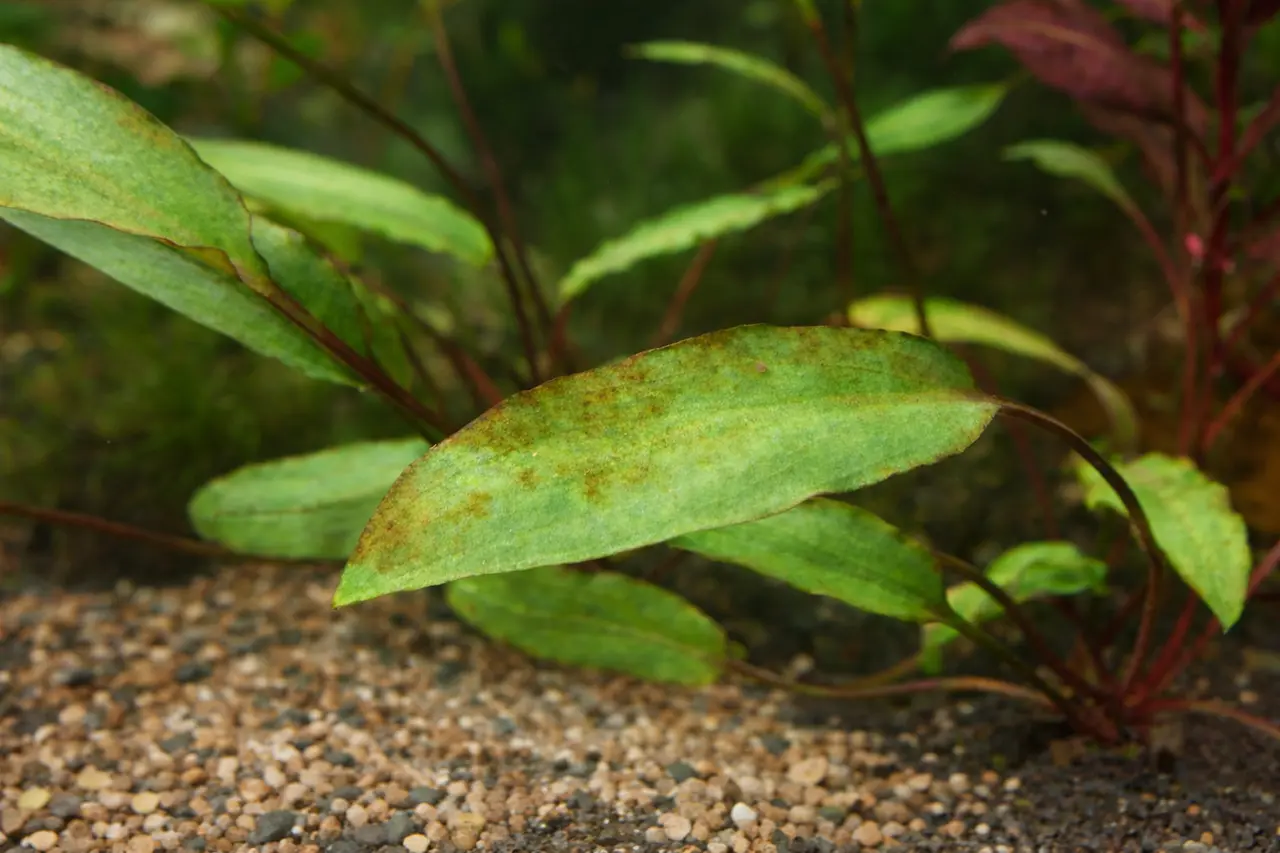
Looks like: brown fuzzy coating on glass, leaves and equipment. Wipes off easily with a finger.
When: first 2–6 weeks of a new tank. Feeds on silicates (SiO₂) from tap water and substrate. Stubborn film is also common in weakly-lit tanks.
Name: these are Bacillariophyta. "True brown algae" (Phaeophyceae) are marine — basically absent in freshwater.
Fix: patience. Once plants start actually growing, diatoms fade on their own. Otocinclus, plecos (suckermouth catfish), or a couple of Nerite snails speed it up.
If they persist for months: test silicates (SiO₂) in your tap water. A durable fix is RO water or a SiO₂-reducing filter cartridge (note: it also reduces PO₄, which you'll then need to dose separately).
Green Spot Algae (GSA)
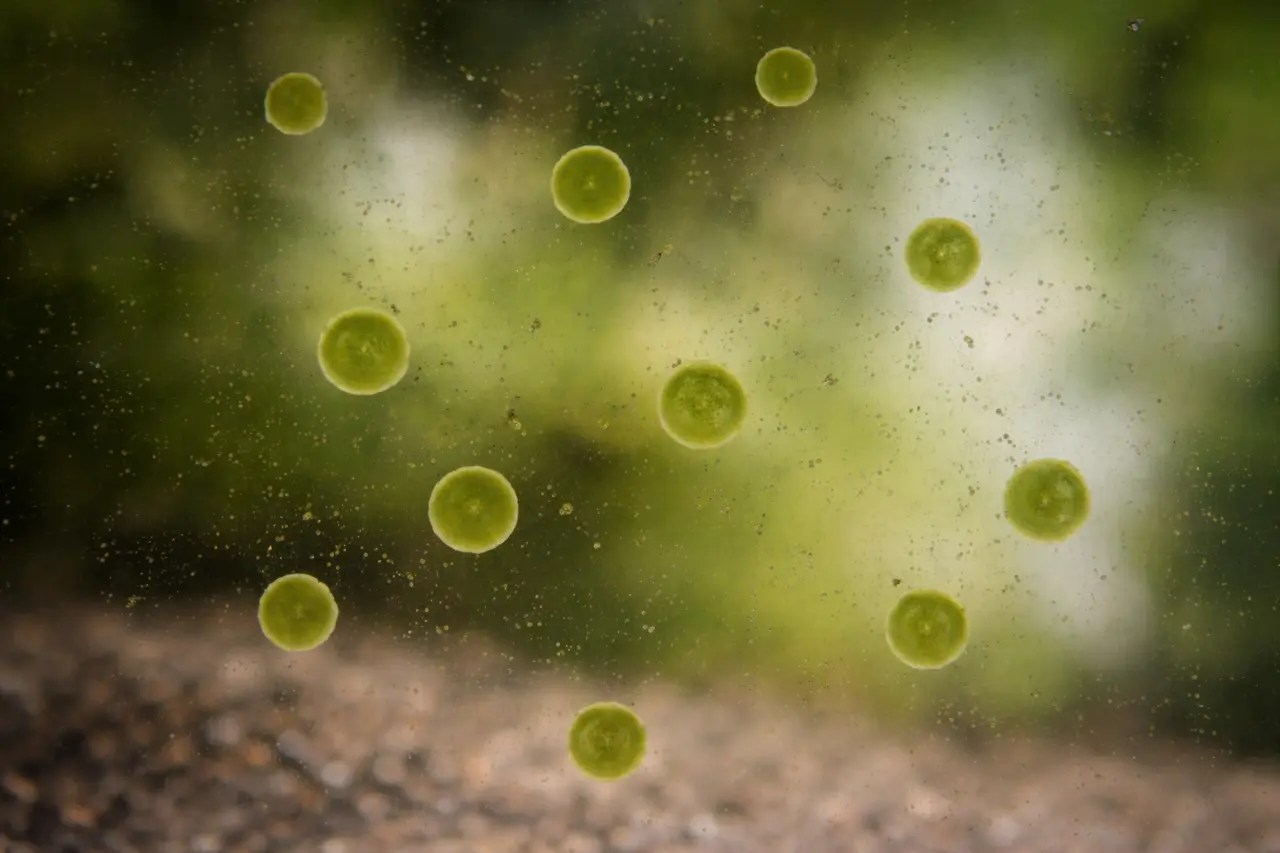
Looks like: hard green dots on glass and older leaves, especially Anubias. Scraped off with a blade.
Cause: disturbed phosphate — either PO₄ deficiency (<0.1 mg/L) or PO₄ excess (>3 mg/L). Strong light is a co-factor — GSA is especially common in brightly-lit tanks.
Taxonomy hint: most likely green algae of the genus Coleochaete.
Fix: if PO₄ <0.1 mg/L — raise to 1–2 mg/L by dosing KH₂PO₄. If PO₄ >3 mg/L — reduce via water changes and less feeding. Consider shortening the photoperiod. After 1–2 weeks new GSA stops forming. Old dots need mechanical removal. The most effective grazers are Clithon (sun snails) and Nerite snails.
Green Dust Algae (GDA)
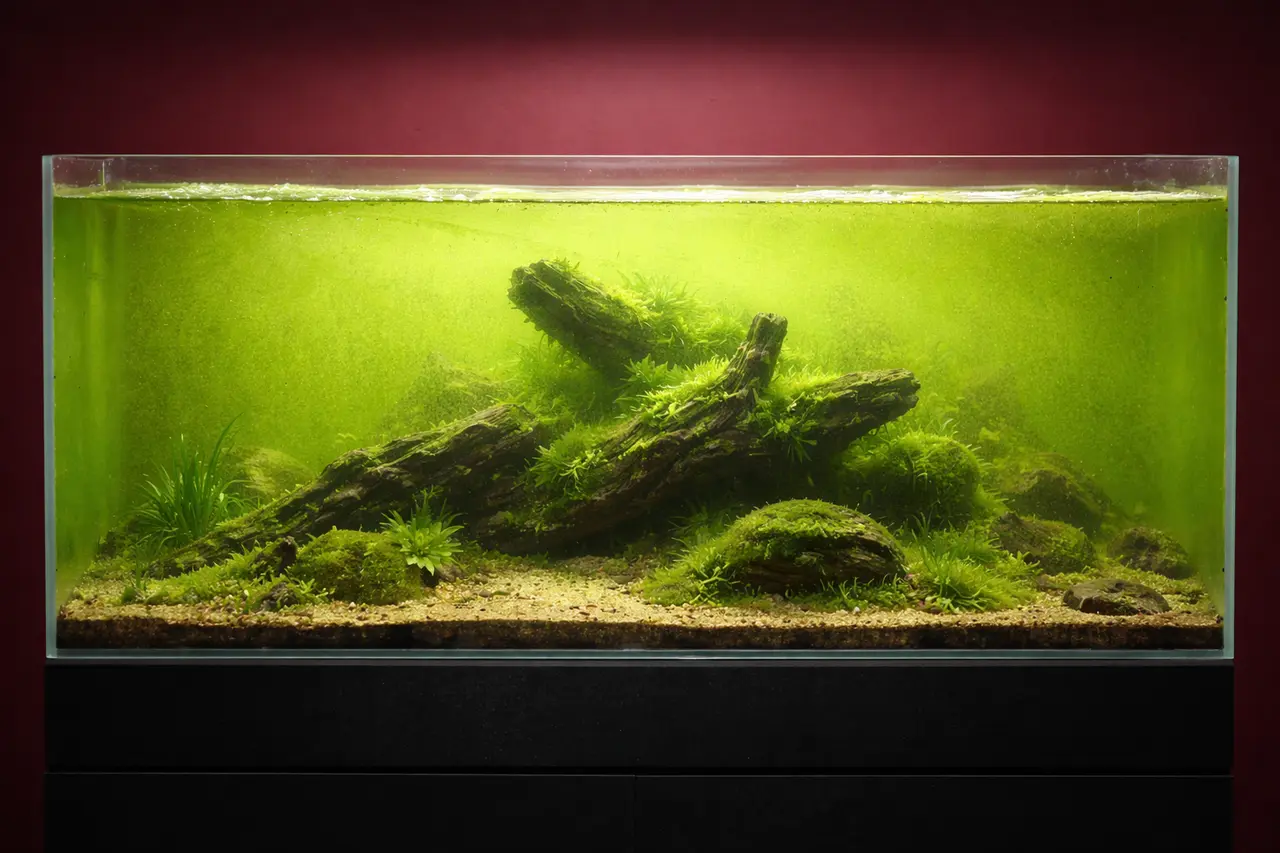
Looks like: a light green film covering glass and surfaces evenly.
Cause: too much light, often in fresh tanks without a mature micro-environment. A common trigger is a sudden nitrogen spike (e.g. dosing magnesium nitrate or urea).
Telling it apart from GSA: GDA wipes off easily with a finger (soft dust); GSA needs a blade.
Fix: leave it alone for 3–4 weeks (do NOT wipe). GDA goes through a life cycle and the old algae detach. Then lower the water level and wipe off the remaining dust by hand, followed by one thorough clean + 50% water change. Wiping mid-cycle "interrupts" it and GDA returns faster.
Emergency option: H₂O₂ treatment (spot-dosing) — see the emergency-measures section.
Green water
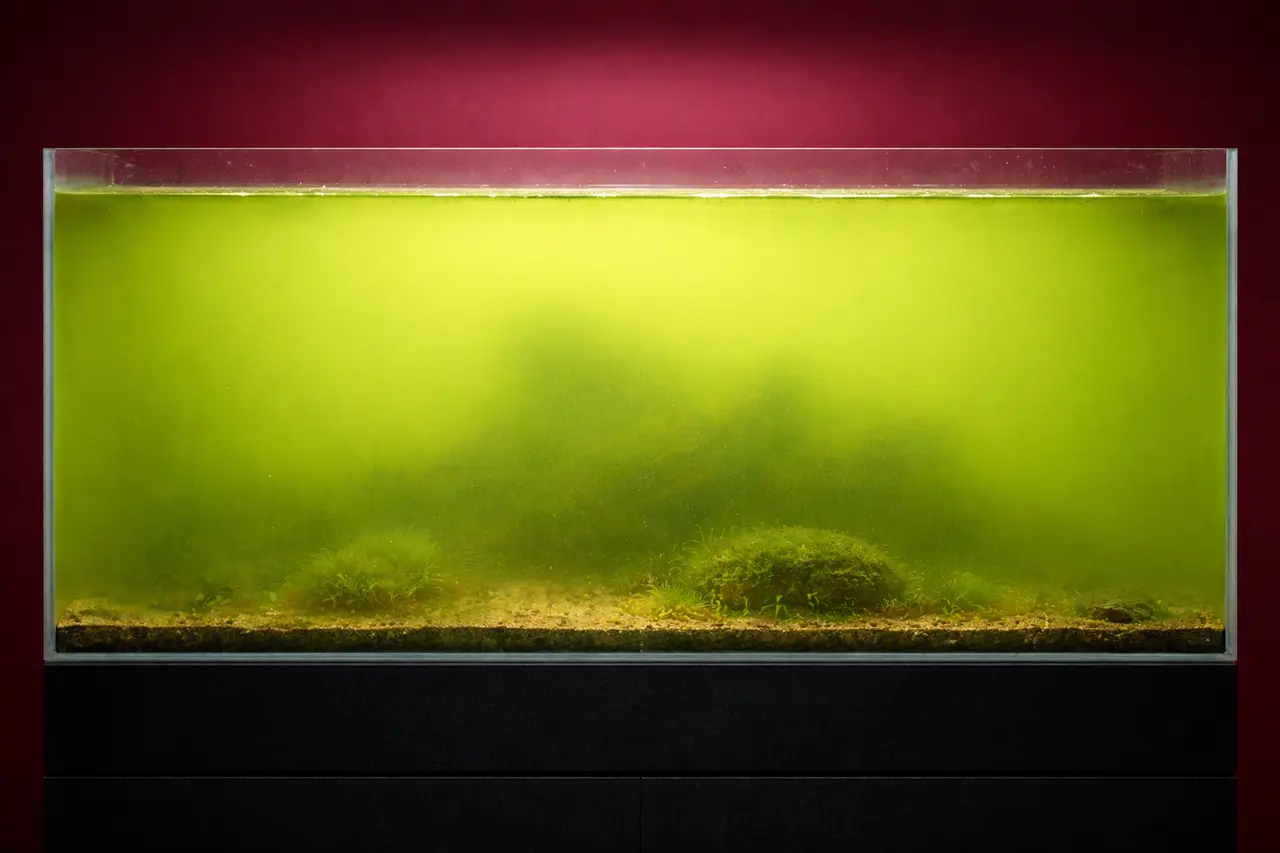
Looks like: the water is pea-soup green, visibility drops to a few centimeters. Single-cell algae floating in the water column.
What it actually is: most often green algae of the genera Chlorella, Ankistrodesmus, Scenedesmus, less commonly the flagellate Euglena.
Cause: excess light + nitrate + PO₄. Typical after a fish dies or from over-feeding. Seasonal pattern: spring and summer, strong sunlight — especially tanks next to a window.
Fix: a combination of big water changes + a 3–4 day blackout + optionally a UV sterilizer (fastest option). After UV has done its job, do a big water change (removes dead algae) and switch the UV off — left on permanently it can degrade chelates in iron fertilisers.
Fish-free tanks: Daphnia works as a natural filter — they graze planktonic algae and clear the water.
Black Brush / Beard Algae (BBA)
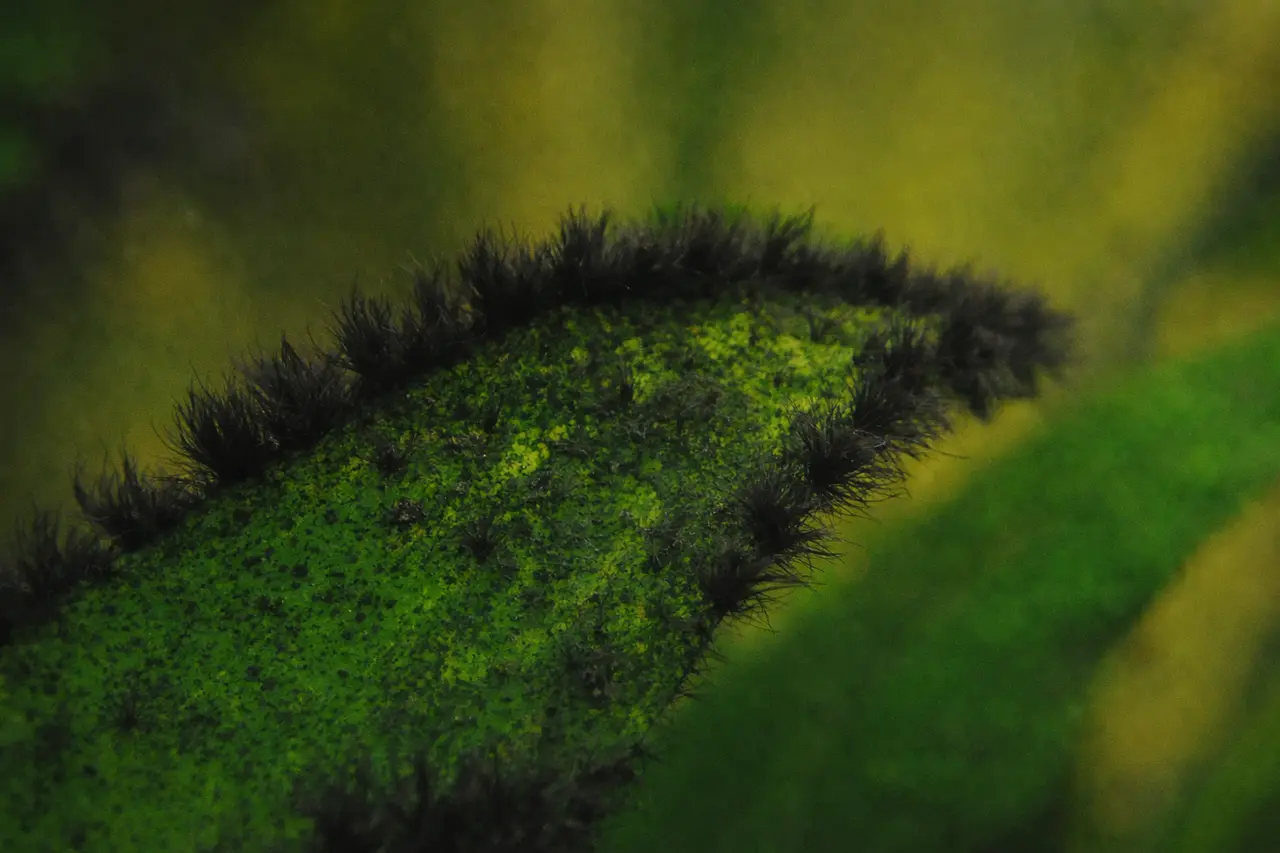
What it is: red algae (Rhodophyta), Audouinella sp. / Rhodochorton sp. — not green algae. Alcohol test: dip a tuft in rubbing alcohol — if it turns reddish / pink, that confirms red algae.
Looks like: dark green to black tufts on leaf edges, driftwood, filter outlets.
Mechanism: under CO₂ deficit, BBA pulls carbon from HCO₃⁻, which raises pH and triggers biogenic decalcification — CaCO₃ precipitates and the algae fortify their cell walls with it. That makes them harder and less appealing to grazers.
Causes — split by tank type:
- Fish-only tanks (no plants): excess organics, skipped water changes, dirty filter and substrate.
- Planted tanks: unstable CO₂, micronutrient imbalance — especially excess iron. Imbalanced N:P (high PO₄ with low NO₃) also favours it.
Fix: dial in CO₂ to a stable 15–30 mg/L throughout the photoperiod, increase filter flow, balance N:P (15–25 NO₃ to 0.5–2 PO₄), check and lower Fe (target 0.05–0.1 mg/L).
Dedicated treatment — Easy Carbo (glutaraldehyde): 1–2 ml per 50 L daily. After a few days algae turn white or pink — that's your signal to stop dosing. Alternative: spot-dosing (local treatment) with 3% H₂O₂ from a pipette with the filter off.
Staghorn algae
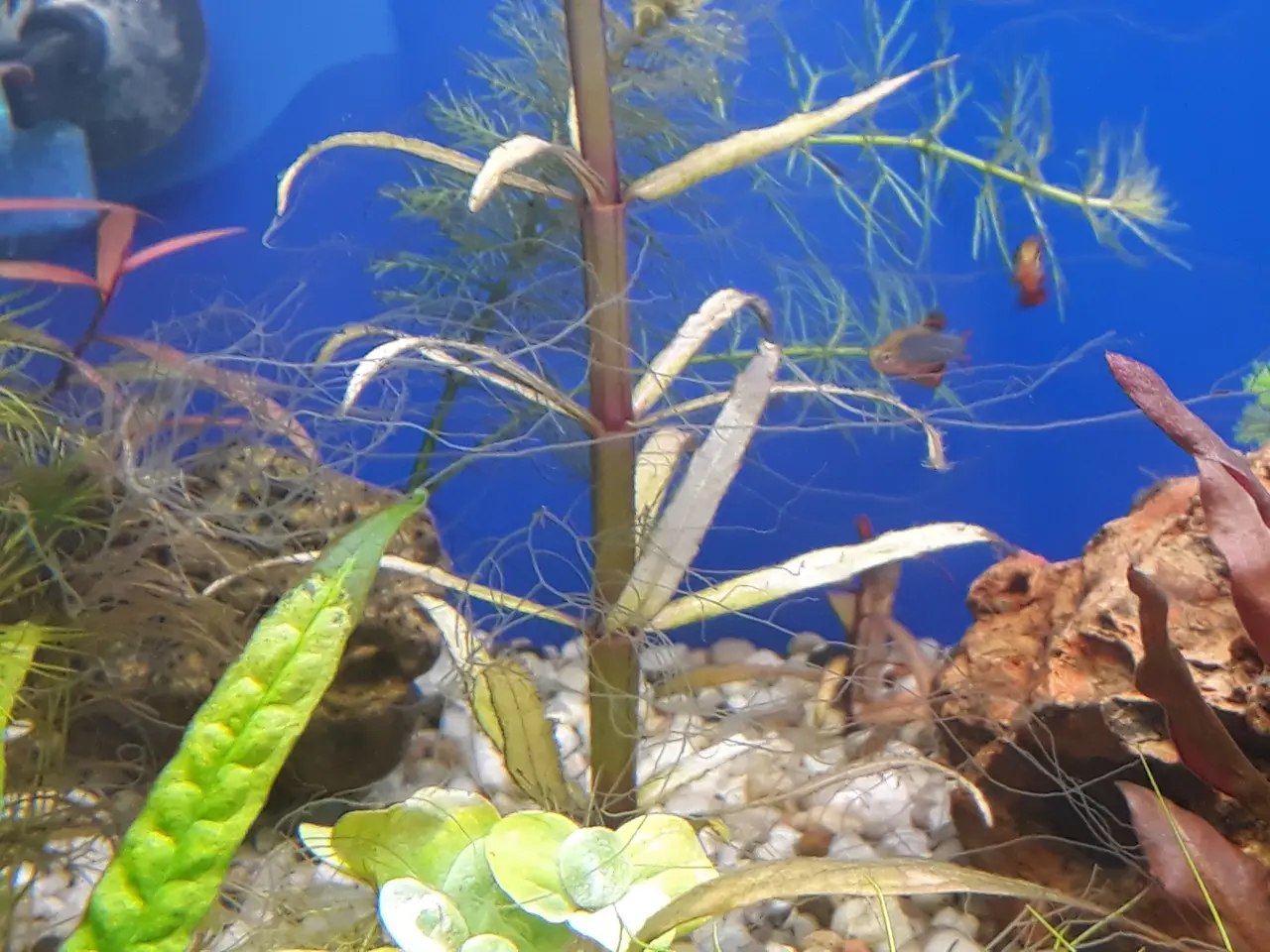
What it is: Compsopogon sp., also a red alga — passes the alcohol test the same way as BBA (turns reddish).
Looks like: grey-green branched tufts resembling deer antlers, on leaf edges and equipment.
Cause: staghorn usually indicates a multi-factorial problem: unstable CO₂, slow plant growth, light/nutrient imbalance. High Fe may co-occur but should not be presented as the sole or primary cause. Target Fe 0.05–0.1 mg/L. Staghorn often travels with BBA.
Liebig's law: a deficiency of one macronutrient (N, P, K or CO₂) causes micronutrients — including Fe — to accumulate in the water and feed red algae. Top up your macros and Fe stops being a problem.
Fix: same as for BBA — stable CO₂, balanced macros, cap Fe. Dedicated: Easy Carbo 1–2 ml per 50 L or spot-dosing H₂O₂ (3%, max 1 ml per 10 L daily).
Note: staghorn is unattractive to most algae eaters — don't count on fish or shrimp, rely on fixing conditions.
Thread / Hair Algae
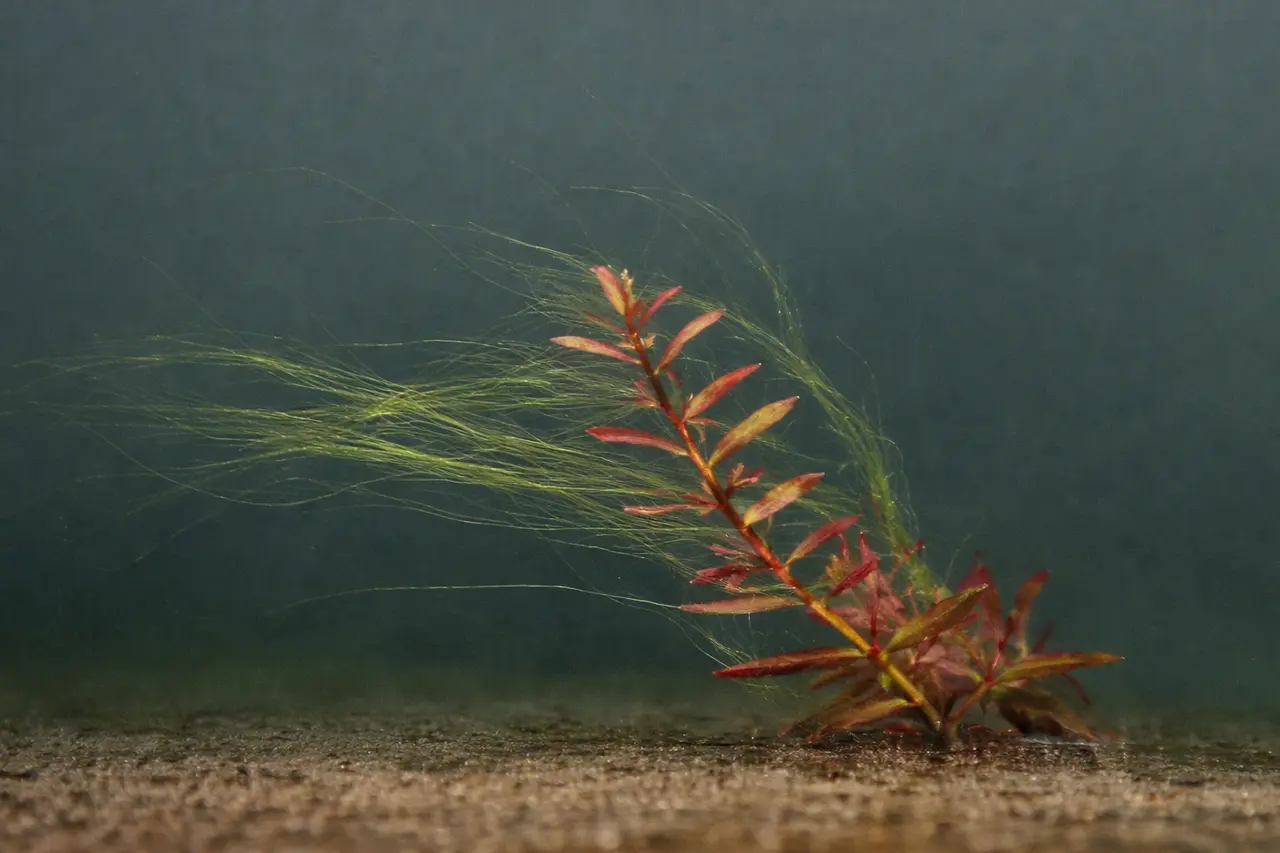
These are two different algae often confused. They respond to similar treatments — but hair is much harder to beat.
Thread algae: long, soft, loose strands (1–10 cm) that detach easily from leaves — you can wind them onto a stick.
Hair algae / Oedogonium: a dense mat or "carpet" on plants, short stiff strands. Much more stubborn than thread — clings hard and keeps coming back.
Cause: usually a combination of factors: imbalanced light vs. plant growth rate, CO₂ instability, and nutrient imbalance. Low NO₃ is one possible contributor, not the only cause. Another factor — photoperiod ramped up too quickly.
Photoperiod: start at 6 h, add 30 min per week. Strong light — max 10 h; weak light — up to 12 h.
Fix: top up NO₃ to 15–25 mg/L (KNO₃), shorten the photoperiod if it was too long, check for Fe overdose. Mechanically — wind threads onto a stick or toothbrush. Grazers: Amano shrimp, Neocaridina, ramshorn snails. Twinstar / UVC sterilizers kill free-floating spores and speed up eradication.
Chemical measures: Easy Carbo alone is often ineffective on hair — H₂O₂ (spot-dosing / local treatment) or a combination of both works better. Don't mix them on the same day — leave at least 24 h between doses.
Safety note: Safety of chemical algicides depends on the specific product and dose. The AlgExit manufacturer declares safety for fish, shrimp and mollusks at label dose — but always observe sensitive species closely after application.
Blue-Green Algae / Cyanobacteria (BGA)
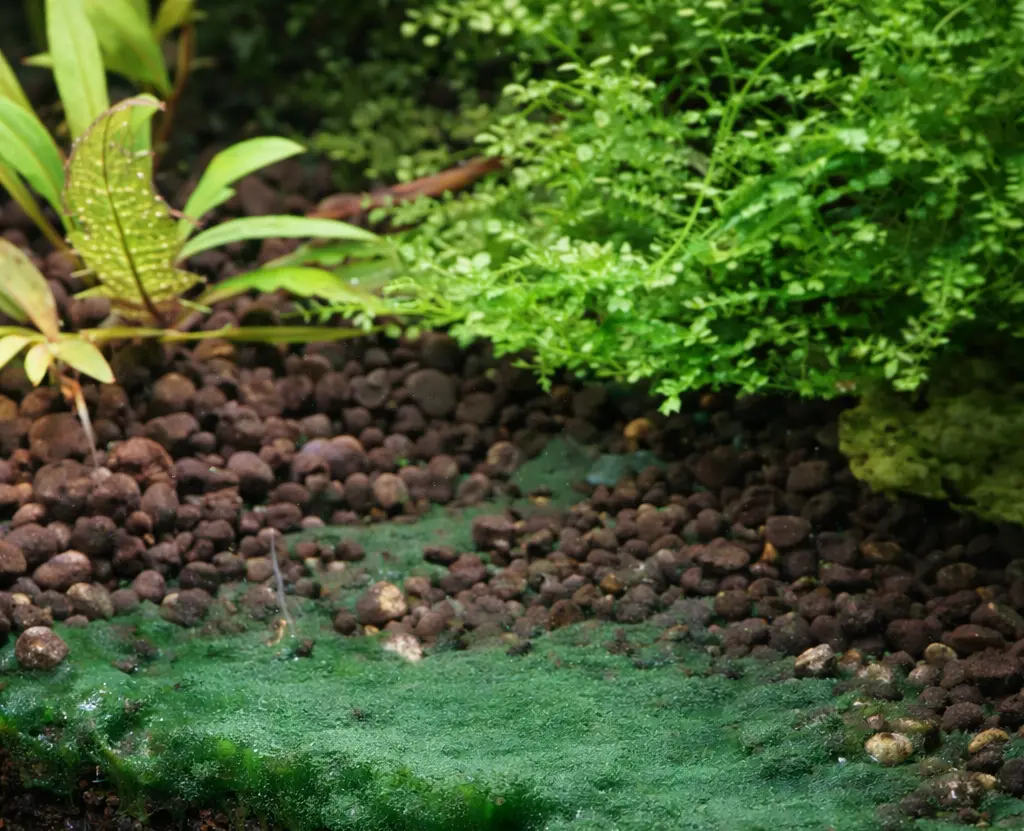
Looks like: dark green slimy "mat" covering large areas, usually substrate or under the filter housing. Smells strongly of mud.
Important: these aren't real algae — they're photosynthetic bacteria. Regular algicides don't work.
Species: usually Oscillatoria (filamentous), Microcystis (planktonic), Nostoc.
Cause:poor water flow (dead zones), low NO₃ (< 5 mg/L), excess organic matter.
Fix — in order:
- 3-day blackout (BGA dies without light).
- Raise NO₃ to 15–20 mg/L (dose KNO₃).
- Check flow — you may need a second filter outlet.
- Potassium treatment: dose K to ~30 mg/L for a week while keeping NO₃ at 20 mg/L, then do a big water change. Safe for the biofilter.
- Spot-dosing H₂O₂ (local treatment) — especially effective when BGA keeps returning in the same spot.
- Bacterial supplements (Special Blend, Nite-Out II) or "seeding" mulm from a mature tank — helps particularly during the cycling phase.
- Blue Exit (Easy Life) — a dedicated product for cyanobacteria, antibiotic-free.
- If steps 1–7 don't help — consult a veterinarian. Do not self-dose antibiotics: they can crash the biofilter and contribute to antimicrobial resistance.
Fuzz algae
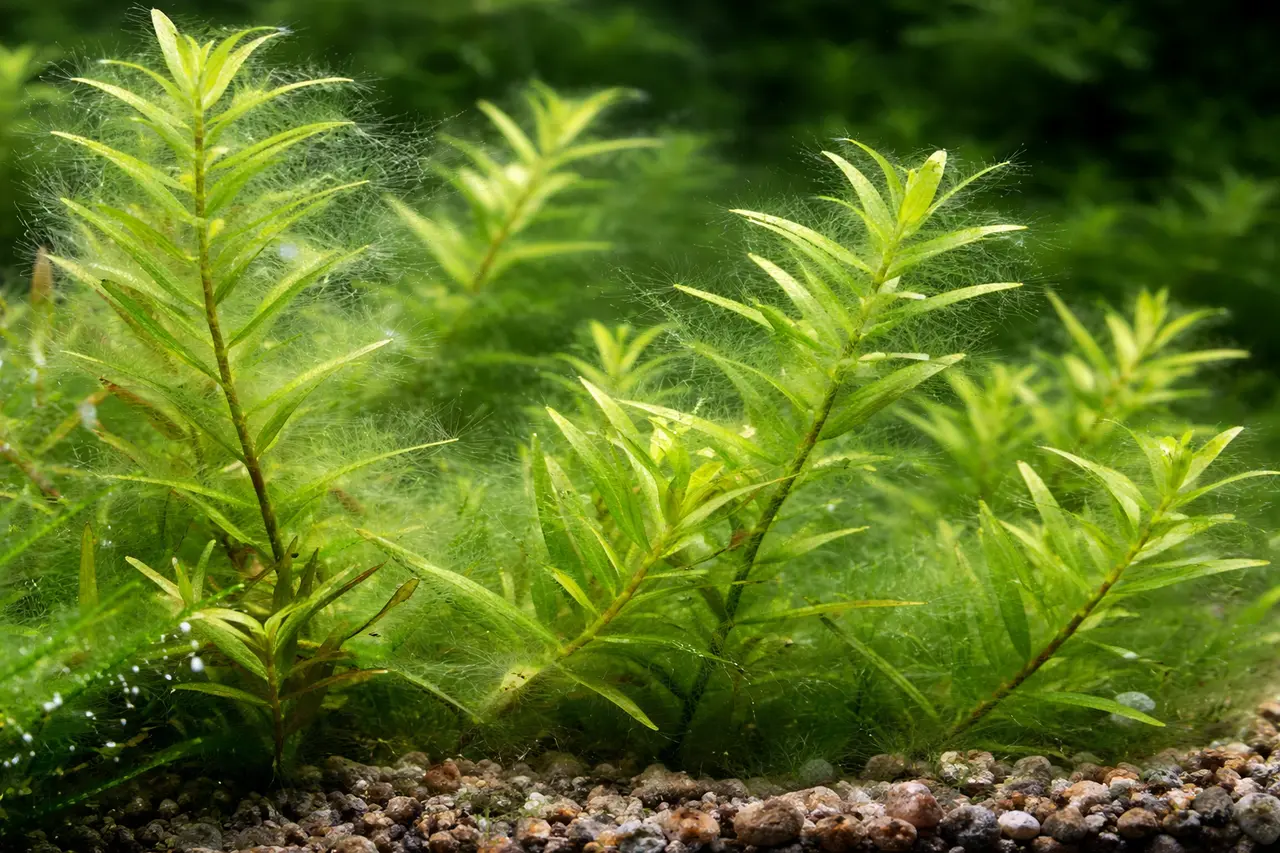
Looks like: short (1–3 mm), light green "fuzz" on leaves and decorations. Especially on young leaves.
When: typically weeks 4–8 of a new tank. In an older tank it usually signals NPK imbalance, not plant "immaturity". A common cause: CO₂ deficit + NPK deficit together.
Taxonomy note: it's unclear whether fuzz is a distinct species or just an early stage of hair algae — the treatment is the same either way.
Fix: patience in a young tank; in an older one — balance NPK and CO₂. An effective combination: Easy Carbo + Amano shrimp. Otocinclus help too.
4. The action plan — what to do in what order
Regardless of algae type, the order of steps is always the same:
- Identify the algae — section 3 above. Without identification you're guessing.
- Measure parameters: NH₃/NH₄, NO₂, NO₃, PO₄, pH, KH, temperature. Note them. That's your baseline.
- Fix the obvious: photoperiod too long, weak flow, unbalanced dosing.
- Manual removal — scrape, pull, prune what you can. Don't leave a pile of algae in the tank "out of spite".
- Big water change (50%) — resets organic compounds and algae spores.
- Wait 2–3 weeks. Algae don't vanish overnight, but they should stop spreading.
- If after 3 weeks there's no progress — chemical measures (H₂O₂, algicides, UV) as a last resort.
5. Prevention — habits that keep algae at bay
Most algae problems can be prevented by a few consistent habits:
Photoperiod
- 6–8 h daily. More only in CO₂-injected, heavily fertilised tanks.
- Timer on the outlet — eliminates "forgetting".
- One long photoperiod rather than two short ones with a break (siesta works, but adds complexity).
Water changes and substrate vacuuming
- 20–30% weekly, without skipping. See our water change frequency guide.
- Vacuum the substrate where food collects (under the filter outflow, around roots).
- Remove dying leaves before they rot — that's the main source of sudden phosphate spikes.
Feeding
- Once a day, only what fish finish in 2 minutes.
- One "fasting day" per week — doesn't hurt fish, cuts the organic load.
- Higher-quality food (less ash = less waste).
Stocking and plants
- Don't overstock beyond the recommended load.
- A densely planted tank = fewer algae (plants out-compete them).
- Fast-growing floaters (hornwort, pistia) are excellent nitrate "sponges" during the maturation phase.
6. Who eats what — algae eaters
Algae eaters are a supplement, not a replacement for diagnosis. But the right ones help keep things tidy.
| Species | Good on | Notes |
|---|---|---|
| Otocinclus | Diatoms, fuzz, thin green | Delicate, min. 6 per group, mature tank only |
| Amano shrimp | Hair algae, fuzz, organic waste | Large (3–5 cm), aggressive grazing, 1 per 10 L |
| Neocaridina shrimp | Soft green, fuzz | Less effective but breed themselves |
| Nerite snails | GSA, diatoms, green film | Don't breed in freshwater, 1 per 20 L |
| Clithon (sun snails) | GSA, GDA (one of the most effective options) | Small, don't breed in freshwater, plant-safe |
| Plecos / suckermouth catfish (Ancistrus, BN pleco) | Diatoms, GDA | Need driftwood to rasp, min. 80 L for a BN pleco |
| Ramshorn snails | Hair, thread, organic waste | Breed on their own — easy to overpopulate, feed sparingly |
| Siamese Algae Eater (SAE) | BBA (one of the few) | Grows large (10+ cm), needs min. 100 L |
| Chinese algae eater | Nothing after 3 months | Avoid — aggressive adult, stops eating algae |
Nothing eats BGA (cyanobacteria). Not shrimp, not snails, not fish. They're bacteria, not algae.
7. Emergency measures — when manual isn't enough
Blackout (3–4 days)
Completely cover the tank with a blanket or cardboard for 3–4 days. Fish and plants survive; algae — especially green water and BGA — die.
- Before: 50% water change.
- During: filter runs, heater runs, light off, tank stays covered.
- After: 50% water change, re-introduce light gradually (4 h day 1, 6 h day 2).
Don't go longer than 4 days — sensitive plants may start dying.
Hydrogen peroxide (H₂O₂) — spot-dosing
Pharmacy-grade 3% H₂O₂ dosed directly from a pipette onto BBA, staghorn, GSA. Throughout this article we use the term spot-dosing consistently (synonyms: local treatment, fogging, point-dosing). Dose: max 1 ml per 10 L tank daily.
- Turn off filter for 15 min after dosing (so it acts locally).
- Dose directly onto algae, not into the water column.
- After 3–4 days of dosing, algae turn black and fall off.
- Kills some plants (Rotala wallichii, Riccia). Test on a single leaf first.
Easy Carbo / glutaraldehyde
A separate chemical method, often confused with H₂O₂. Liquid-carbon products vary between brands — always dose per the specific product's label. Seachem markets Flourish Excel as an organic carbon source, not an algicide; local overdose can damage plants.
- Dose: 1–2 ml per 50 L daily for a week.
- When algae start turning white or pink — stop dosing. Continuing no longer helps and can harm plants.
- Works on: BBA, staghorn, fuzz, partially on hair (often better combined with H₂O₂).
- Caution: Vallisneria and some mosses don't tolerate glutaraldehyde — it can damage them.
UV filter
Fastest fix for green water and waterborne bacteria. UV kills microorganisms as they pass through the lamp.
- For 100 L: 5–9 W is enough.
- Run for several days until the water clears fully — effectiveness depends on wattage relative to tank volume and flow rate.
- Doesn't work on algae attached to surfaces (BBA, GSA etc.).
Chemical algicides (last resort)
Easy-Life AlgExit, Seachem Flourish Excel (low dose), API Algaefix. Effective, but:
- Can hurt sensitive plants (Vallisneria, Elodea).
- Safety varies by product and dose — check the specific product's label. Always observe the tank after application, especially shrimp and snails.
- Treats the symptom, not the cause — algae return if conditions don't change.
8. When to give up and rescape
Sometimes the fight isn't worth it. Consider a reset if:
- BBA covers 50%+ of plants and equipment despite 2 months of CO₂ and dosing tweaks.
- BGA returns after every treatment course.
- The tank is in "slow collapse" — plants dying, algae growing, nothing helps.
- Mental fatigue — fishkeeping is supposed to be fun.
Rescape: take everything out (fish into a bucket of tank water, plants cleaned of algae, filter and media preserved), toss the substrate (especially if BGA), clean the glass, refill. Preserving the filter means you don't have to cycle from scratch — but still monitor NH₃/NH₄ and NO₂ for the first 1–2 weeks, as a major reset can cause a mini-cycle even with mature media.
9. FAQ
Why does my new tank have algae?
The first 6–8 weeks are the "algae window" — plants don't have mature roots yet, bacteria aren't fully active. Diatoms and GDA are normal. Don't panic, don't break the cycle, don't up dosing in reaction.
Dim the lights or shorten the photoperiod?
Shorten the photoperiod. Dimming (timer ramp, dimmer) rarely helps — plants don't grow, algae adapt to weaker light.
Do algae hurt fish?
Algae themselves are mainly an aesthetic problem, but mass cyanobacteria blooms can produce toxins harmful to fish, invertebrates, and humans in contact with the water or aerosol. Euglena (green water) is usually safe but drastically reduces visibility and plant photosynthesis.
I bought an algicide and algae came back after 2 weeks.
Because you didn't fix the cause. The algicide killed existing algae, but conditions (excess light, unstable CO₂, macro deficiency) still favour regrowth. Diagnose the environment, not just the symptom.
How much algae is "too much"?
Up to 10% coverage on leaves and glass is normal. Above — time to act. A completely algae-free tank usually means excessive hygiene (algicides, UV), which brings its own problems.
Can heavy EI dosing "beat" algae?
Paradoxically yes. The Estimative Index method (large macro doses + 50% weekly water change) works by letting plants outpace algae. But it needs CO₂ and strong light — without those, EI is just expensive fertilising.
I have green water and don't want to do a blackout. What else?
UV filter (5–9 W for 100 L) — run for several days until the water clears. Effectiveness depends on wattage relative to tank volume and flow rate.
Wrap-up
Algae are a signal to diagnose, not panic. Start with identification, measure parameters, fix the obvious (photoperiod, CO₂, dosing) and give it 2–3 weeks. Mechanical removal (scraping, pruning, siphoning) is fine; chemical is last resort.
The best anti-algae tank is stable, densely planted, consistently fertilised, with a reasonable photoperiod and regular water changes. Nail those basics and algae will stay at trace levels — which is exactly how it should be.
Related: complete water parameters guide — if you don't know your NO₃, PO₄ and CO₂, you don't know what to fix.